

Periodontitis and overall health: the links with diabetes, heart and brain
Periodontitis is not just a problem of the mouth. What we know about its links with diabetes, cardiovascular and neurodegenerative diseases, and other systemic diseases.
Bleeding gums are easy to brush off, especially when they do not hurt. But looking after your gums is about more than a healthy-looking smile: it helps protect the tissues that hold your natural teeth in place.
Periodontitis is a chronic inflammation of the tissues that support the teeth. For a long time it was considered a problem confined to the mouth. Research now shows that it is linked with the health of the whole body, and that some general diseases can in turn favour it. Some links are well established; others, including those involving cognitive decline, are still being investigated.
Here is what we know, separating what has been demonstrated from what is still being studied.
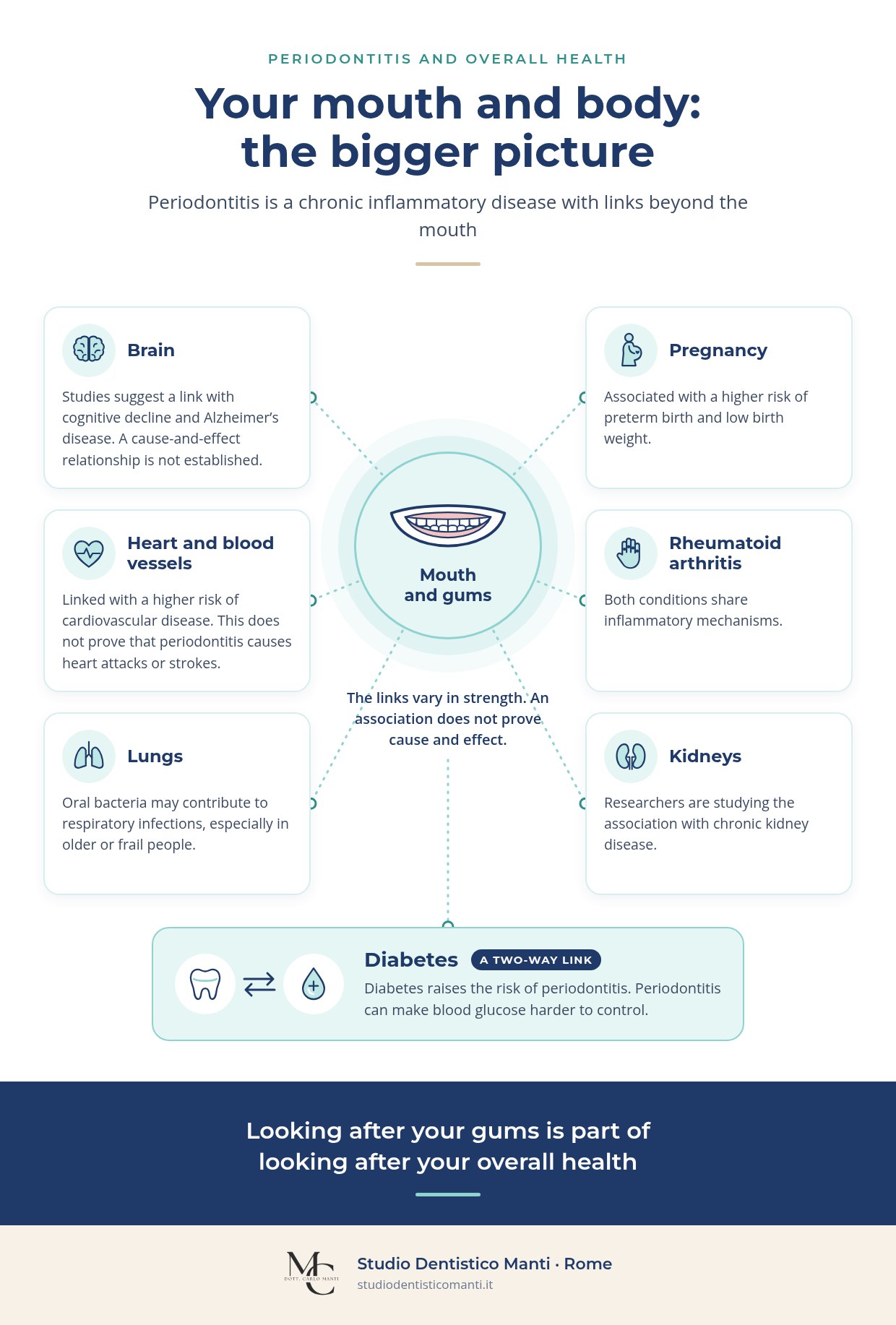
How can periodontitis affect the rest of the body?
In periodontitis, the gum tissues are persistently inflamed. Through these tissues, bacteria and inflammatory substances can enter the bloodstream and contribute to low-grade systemic inflammation throughout the body.
This is the main mechanism researchers propose to explain the links between periodontitis and several systemic diseases. It does not mean that everyone with periodontitis will develop another illness, or that periodontitis is the sole cause of any of the conditions below.
Diabetes and periodontitis: a bidirectional relationship
This is the most studied and most robust of these links, recognised as bidirectional by international periodontology and diabetes societies. It works in both directions:
- Diabetes increases the risk of periodontitis, and of more severe periodontitis, especially when diabetes is poorly controlled.
- Periodontitis makes blood glucose harder to control, because chronic inflammation worsens the body’s response to insulin.
The two diseases reinforce one another. This is why close collaboration between your dentist and your diabetologist (diabetes specialist) is now recommended. If you have diabetes, let your dentist know and mention any bleeding, swelling or changes in your gums.
Cardiovascular disease: an association, not proof of a cause
People with periodontitis have, on average, a higher risk of cardiovascular disease, such as heart attack and stroke. The leading hypothesis is that chronic inflammation contributes to arterial damage, and bacteria typical of the mouth have been found in some atherosclerotic plaques.
However, this is an association: it has not been shown that periodontitis on its own causes these events, partly because it shares risk factors with cardiovascular disease, such as smoking and diabetes. We cannot say that treating periodontitis will prevent a heart attack or stroke. Periodontitis is nonetheless now recognised by cardiology bodies, such as the World Heart Federation, as a condition associated with higher cardiovascular risk.
Caring for your gums belongs alongside — not instead of — the advice and treatment you receive for your heart.
Neurodegenerative diseases
This is the newest area of research. Some studies have observed that people who have had periodontitis for many years have a slightly higher risk of cognitive decline and Alzheimer’s disease. In some research, one of the bacteria typical of periodontitis has been detected in brain tissue from people with Alzheimer’s disease.
The risk appears small but possible, and it is still being studied. A causal relationship has not been established: it would be misleading to say that periodontitis causes Alzheimer’s disease, or that periodontal treatment prevents dementia.
For more background, see our earlier article, Healthy gums, an active mind — currently available in Italian.
Other associations being studied
- Pregnancy: periodontitis in expectant mothers has been associated with a higher risk of preterm birth and low birth weight. This association does not mean that periodontitis will cause a pregnancy complication.
- Rheumatoid arthritis: the two diseases share inflammatory mechanisms and often occur together.
- Respiratory diseases: in older or frail people, bacteria from the oral cavity can contribute to pneumonia.
- Chronic kidney disease: chronic inflammation appears to weigh on both conditions; researchers are still investigating the association.
In summary
Periodontitis is not only a disease of the teeth and gums. The link with diabetes is firmly established, the link with cardiovascular disease is well documented, and the link with neurodegenerative diseases is a plausible hypothesis that research is actively investigating. The evidence is not equally strong for every condition: gum health is part of general health, not a reason to assume the worst.
Bleeding gums? Start with an assessment
Bleeding, swollen gums or teeth that feel loose deserve attention. Bleeding does not automatically mean you have periodontitis: a dental assessment is needed to understand the cause and check the tissues supporting your teeth.
The aim of periodontal care is to control the disease and help preserve your natural teeth wherever possible. The right approach depends on what the examination shows. You do not need to wait for pain before asking for advice.
Periodontitis treatment in Rome, with your natural teeth in mind
If you live in Rome and are concerned about your gums, Studio Dentistico Manti welcomes English-speaking patients. Dr Carlo Manti speaks English, so you can discuss your concerns and understand the proposed care without a language barrier.
To arrange a periodontal assessment, contact the practice at Via Aristide Leonori 110, 00147 Rome. Call +39 06 69 20 00 06 or send a WhatsApp message to +39 351 55 25 633. If you would prefer your appointment in English, mention this when you get in touch.
Find out more about care with an English-speaking dentist in Rome.
Frequently asked questions
What is the connection between diabetes and periodontitis?
It is a bidirectional relationship: diabetes increases the risk and severity of periodontitis, particularly when it is poorly controlled, and periodontitis makes blood glucose harder to control.
Can periodontitis cause a heart attack?
It has not been shown that periodontitis on its own causes a heart attack, but it is associated with a higher cardiovascular risk. Treating your gums does not replace medical care for your heart.
Is periodontitis linked to Alzheimer’s disease?
Some studies have found an association, but the link is still being researched and has not been proven. There is no evidence that periodontal treatment prevents dementia.
By Dr Carlo Manti, dentist at Studio Dentistico Manti, Rome. His approach focuses on preserving natural teeth wherever possible.
This article provides general information and does not replace an individual dental or medical assessment.
Studio Dentistico Manti
VAT no. 11580581004

