

Painful root canal treated tooth: can it still be saved?
A root canal treated tooth that hurts can often still be saved. Causes, root canal retreatment, apicectomy, which tests you need and when to act.
Yes, a root canal treated tooth that hurts can often still be saved. Pain does not, on its own, mean that the tooth has to be extracted. The first step is to understand where the problem comes from and whether the tooth can be saved with root canal retreatment.
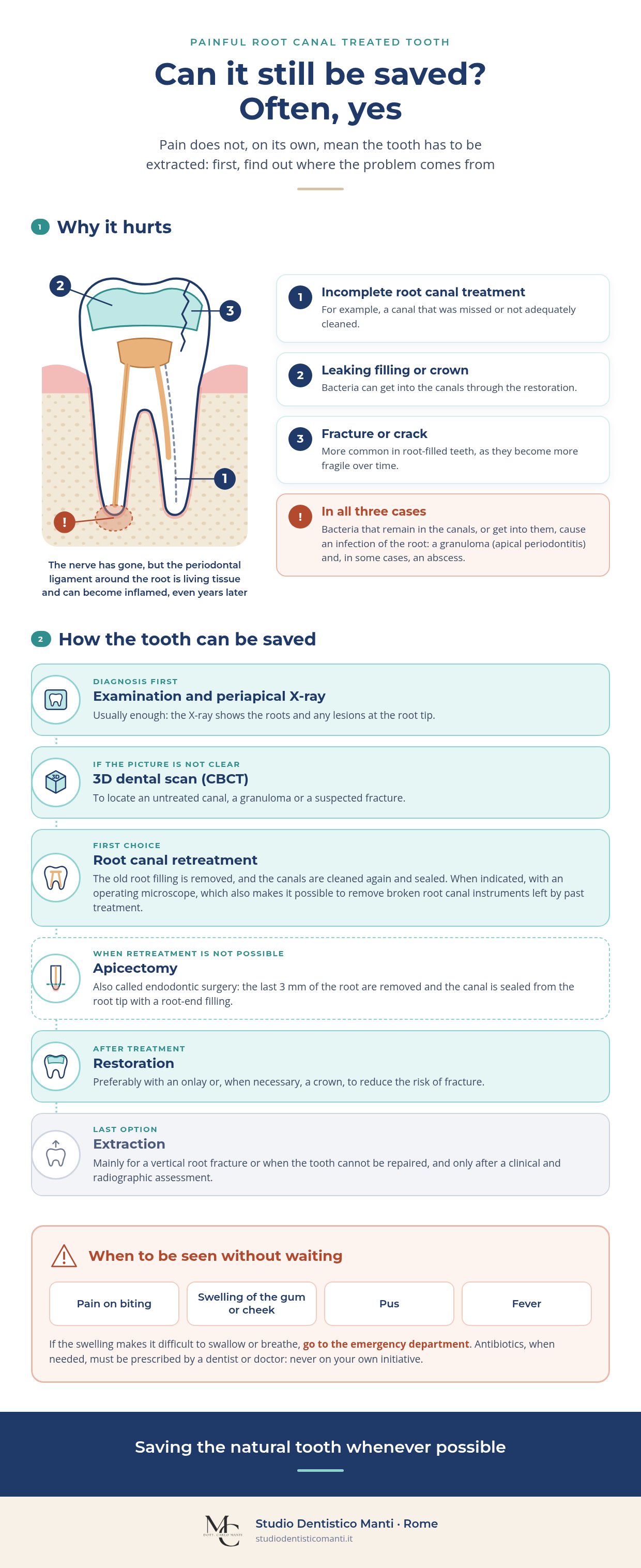
Why can a tooth that has had root canal treatment hurt?
Root canal treatment (in Italian, devitalizzazione) removes the pulp, the tissue inside the tooth that contains the nerve. The tooth, however, remains anchored to the bone by the periodontal ligament, which is living tissue and can become inflamed. This is why the tooth can hurt even years later.
There are essentially three common causes:
- incomplete root canal treatment, for example a canal that was missed or not adequately cleaned;
- a leaking filling or crown;
- a fracture or crack, which is more common in root-filled teeth, as they become more fragile over time.
In all three cases, bacteria that remain in the canals, or that get into them, cause an infection of the root. This leads to a lesion at the root tip, known as a granuloma (apical periodontitis), and in some cases to an abscess.
Can it be saved, or does it need to come out?
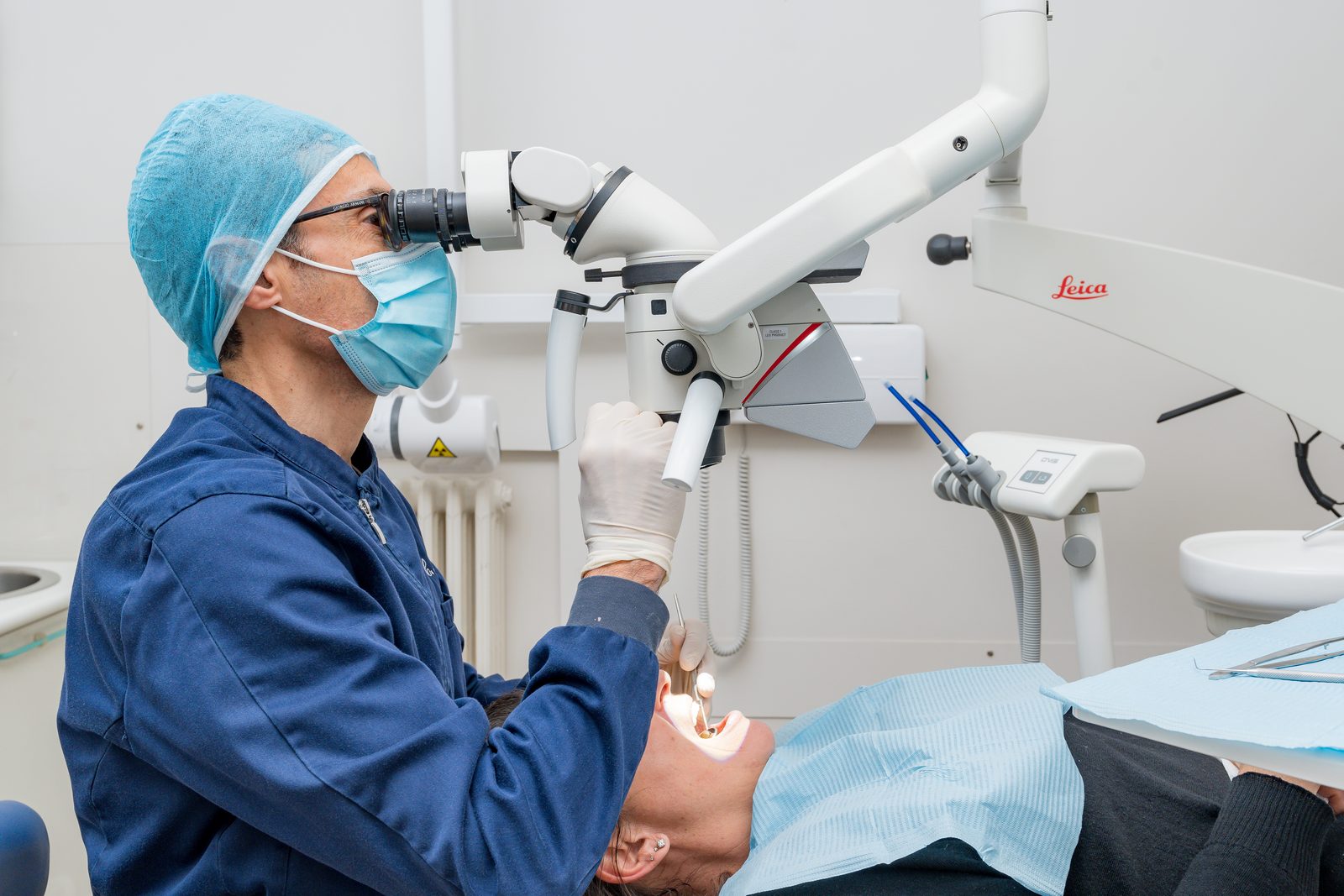
It depends on the cause and on how much sound tooth structure is left. When the prognosis is favourable, the first choice is root canal retreatment (endodontic retreatment): the old root filling is removed, and the canals are cleaned again and sealed. At Studio Dentistico Manti, when indicated, an operating microscope can be used. It helps to see and treat complex canals or canals missed in previous treatment, and to remove broken (separated) root canal instruments left behind by past treatment.
As a last option, if root canal retreatment cannot be carried out, an apicectomy (also spelled apicoectomy), or endodontic surgery, is considered. This means removing the last three millimetres of the root (root-end resection) and sealing the canal from the root tip with a root-end filling.
If the tooth is weakened, after treatment it needs to be properly restored, preferably with an onlay or, when necessary, a crown, to reduce the risk of fracture.
Extraction is considered mainly in the case of a vertical root fracture, or when the tooth structure cannot be repaired, and only after a clinical and radiographic assessment. It is the same approach described on our Endodontics and Save your tooth pages (in Italian): saving the natural tooth whenever possible.
Which tests are needed?
Usually an examination and a periapical radiograph (dental X-ray) are enough: it shows the roots and any lesions at the root tip. If the picture is not clear, a 3D dental scan, known as cone beam CT (CBCT), may be needed, for example to locate an untreated canal, a granuloma or a suspected fracture.
When should you be seen without waiting?
If you have pain on biting, swelling of the gum or cheek, pus or a fever, it is best to be seen as soon as possible. If the swelling makes it difficult to swallow or breathe, go to the emergency department (pronto soccorso). Antibiotics, when needed, must be prescribed by a dentist or doctor: do not take antibiotics on your own initiative.
Frequently asked questions
Can a root canal treated tooth hurt even many years later?
Yes. The nerve inside is no longer there, but the tissues around the root are alive and can become inflamed, even a long time afterwards.
If there is a granuloma, does the tooth have to come out?
No. It can often be treated while keeping the tooth. Extraction is only considered if the tooth cannot be saved.
After retreatment, is the tooth “fixed”?
Treating the canals is only part of saving the tooth. The tooth also needs a stable restoration, preferably an onlay or, when necessary, a crown, because an unprotected root-filled tooth fractures more easily.
For an endodontic assessment, contact Studio Dentistico Manti, Via Aristide Leonori 110, Rome: +39 06 69 20 00 06, WhatsApp +39 351 55 25 633.
By Dr Carlo Manti, dentist at Studio Dentistico Manti, Rome. His approach focuses on preserving natural teeth wherever possible.
This article provides general information and does not replace an individual dental or medical assessment.
Studio Dentistico Manti
VAT no. 11580581004

